Broken Bone Without a Cast: Is It Safe, and Can It Heal?
Can a broken bone heal without a cast? It depends on the bone, the type of break, your age, and your doctor's advice. Learn what affects healing.
On this page
A cast is the most familiar and common treatment for a broken bone (fracture). When a break is not too severe, the injured bone needs to be held in the right position and kept from moving so it can heal. In those cases, a doctor will often recommend a cast. So what happens if you have a broken bone and don’t wear a cast?
A cast is a safe, noninvasive treatment. But it can limit your movement and make daily life harder. This guide explains how casts help broken bones heal, and which factors decide whether a broken bone can heal without one.
How does a cast help a broken bone heal?
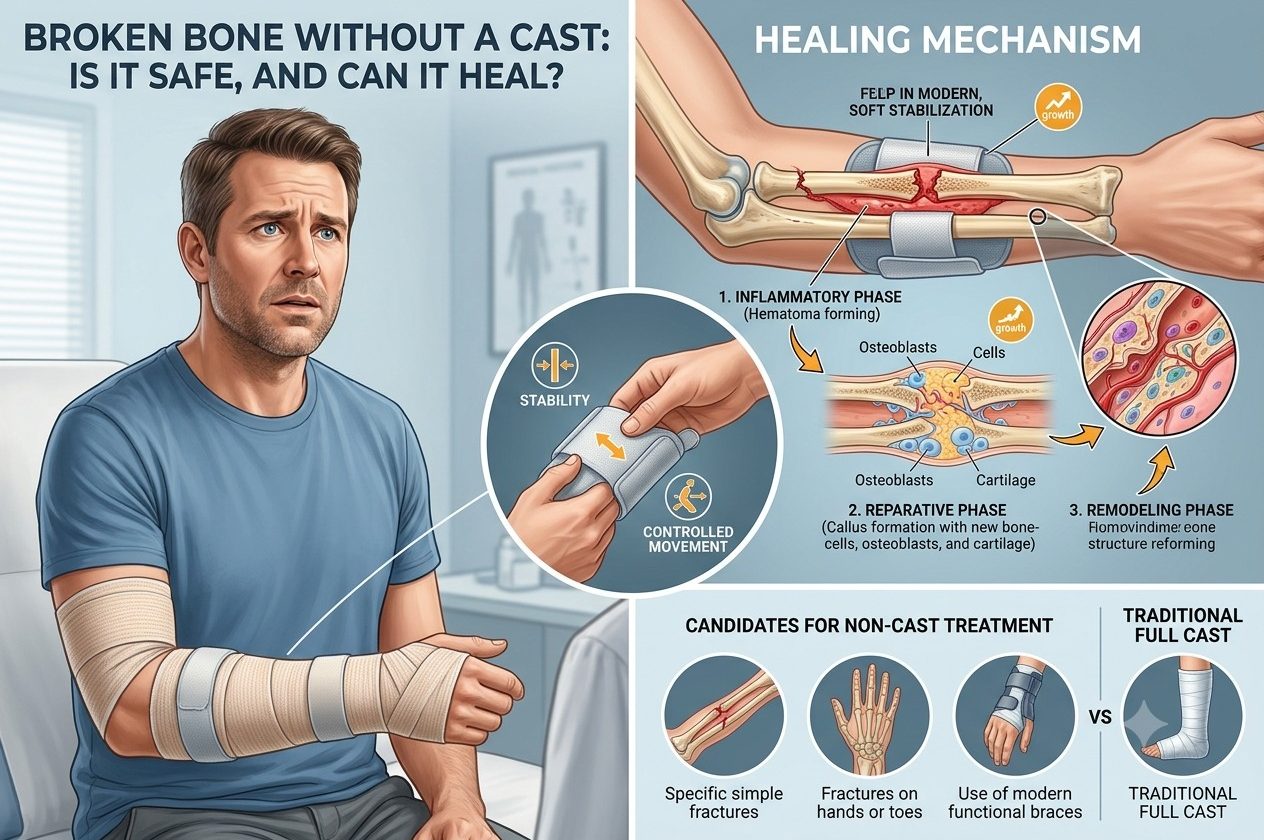
Bone healing happens in three stages:
- Inflammation and cleanup. Blood vessels are damaged by the break. Immune cells travel to the injury to clear away small bone fragments, which causes inflammation.
- New bone cell growth. Bone-building cells (osteoblasts) produce new bone cells.
- Remodeling. The bone keeps forming and becomes hard and strong.
It takes time for the broken pieces to join back together. During that time, the injured area has to stay still, because any movement of the bone pieces slows healing. That is why doctors often recommend a cast to hold the broken bone in place and speed up recovery.
A cast can also be uncomfortable and inconvenient. Many people with a broken bone worry about it and ask whether they really need one.
Is it safe to have a broken bone without a cast?
The answer depends on several factors. Here are the main ones.
Where the bone is broken
The location of the break plays a big role in whether a bone can heal without a cast. Some bones may heal without one, such as the collarbone (clavicle), wrist, fingers, and ankle. Others can’t be put in a cast at all, such as the pelvis and the neck of the thigh bone (femoral neck).
Type of fracture
There are many types of fractures: transverse (straight across), oblique (diagonal), spiral (twisting), comminuted (shattered into several pieces), and breaks in multiple segments. Some injuries are more likely to heal without a cast than others. A clean break in which the ends of the bone stay lined up is more likely to heal without a cast than a displaced fracture, where the broken ends are no longer lined up.
Age
Age can also matter. Younger people tend to heal faster than older adults, because a child’s bones are still growing and have a good blood supply.
Complications
A broken bone, like any injury, can have complications. If complications develop, a doctor may need to put the bone in a cast. Possible complications include infection and problems with blood flow to the area.
Every injury is different, so your doctor will look at the full picture and decide on the right treatment. In some cases, a bone could heal without a cast in theory, but a doctor may still recommend one to be safe.
Following care instructions
Sometimes a doctor may decide against a cast if they believe the patient is able and knows how to care for the injured bone. This decision usually depends on age, occupation, and how well the person follows instructions. For example, a person with a low-activity job might use a splint or another type of support instead of a cast if the injury is not severe.
So, is a broken bone without a cast a problem?
It depends on the situation. If your doctor has weighed these factors and decided you don’t need a cast, that is perfectly normal. But if your doctor has recommended a cast, you should follow that advice. A broken bone that is not treated properly can heal in the wrong position or, in more serious cases, lead to bone tissue death (necrosis). That is why it is important to get medical care as soon as possible after a fracture.
What can you do to help a broken bone heal?
- Follow your doctor’s activity instructions. Some fractures may need movement and weight bearing to speed up healing. Others need to be kept still, and you should avoid carrying heavy loads.
- Eat a balanced diet. Protein and vitamins C, D, and K are needed for broken bones to heal. Calcium, magnesium, phosphorus, and zinc are also needed for bone formation and can speed up healing.
- Don’t smoke. Smoking reduces blood flow through the smallest blood vessels (capillaries), which is needed for healing.
- Keep blood sugar steady if you have diabetes.
Frequently asked questions
Does a broken shoulder bone need a cast?
A broken shoulder may be held in place with a cast, a splint, or a sling or strap. Your doctor will choose what fits your injury.
Do broken ribs need a cast?
No. Casts are not used for broken ribs. Treatment includes rest, pain relief, and breathing exercises.
Does a broken fibula need a cast?
The fibula is a long, thin bone on the outer side of the lower leg, next to the shinbone (tibia). A broken fibula usually needs a cast or a splint to hold it in place.
Does a broken collarbone need a cast?
No. A cast is not used to treat a broken collarbone. If the broken bone is still lined up, treatment is a sling or strap. If the broken ends have moved out of line, surgery may be needed.
Does a broken toe need a cast?
A minor broken toe usually only needs to be taped to the toe next to it (buddy taping). If the injury is more serious, a doctor may put the toe in a cast.
The bottom line
A cast is an effective and safe way to hold a broken bone in place while it heals. Whether you can do without one depends on the situation. If you think someone has a broken bone, the best step is to get them to a medical facility for a diagnosis and advice on treatment.
References
Medical disclaimer
FAQHealth content is for informational and educational purposes only. It is not a substitute for professional medical advice, diagnosis, or treatment. Always talk with your doctor or another qualified health professional about any questions you have about a medical condition.