Hypertensive Retinopathy: Symptoms, Causes, and Treatment
Hypertensive retinopathy is eye damage caused by high blood pressure. Learn the stages, symptoms, causes, treatment, and how to protect your vision.
On this page
- What is hypertensive retinopathy?
- What are the symptoms of hypertensive retinopathy?
- What causes hypertensive retinopathy?
- Is hypertensive retinopathy dangerous?
- How is hypertensive retinopathy diagnosed?
- How is hypertensive retinopathy treated?
- How can you prevent hypertensive retinopathy?
- What is the outlook?
High blood pressure rarely causes symptoms, but it can quietly harm the heart and blood vessels. That includes the blood vessels in the retina, the light-sensing layer at the back of the eye. This damage is called hypertensive retinopathy.
This guide explains what hypertensive retinopathy is, its stages and symptoms, what causes it, how it is diagnosed and treated, and how to prevent it.
What is hypertensive retinopathy?
Blood pressure that is not well controlled can harm several organs, including the heart, the kidneys, the blood vessels of the brain, and the retina. In the eye, high blood pressure can cause retinopathy (damage to the retina), optic neuropathy (damage to the optic nerve), and choroidopathy (damage to the layer of blood vessels beneath the retina).
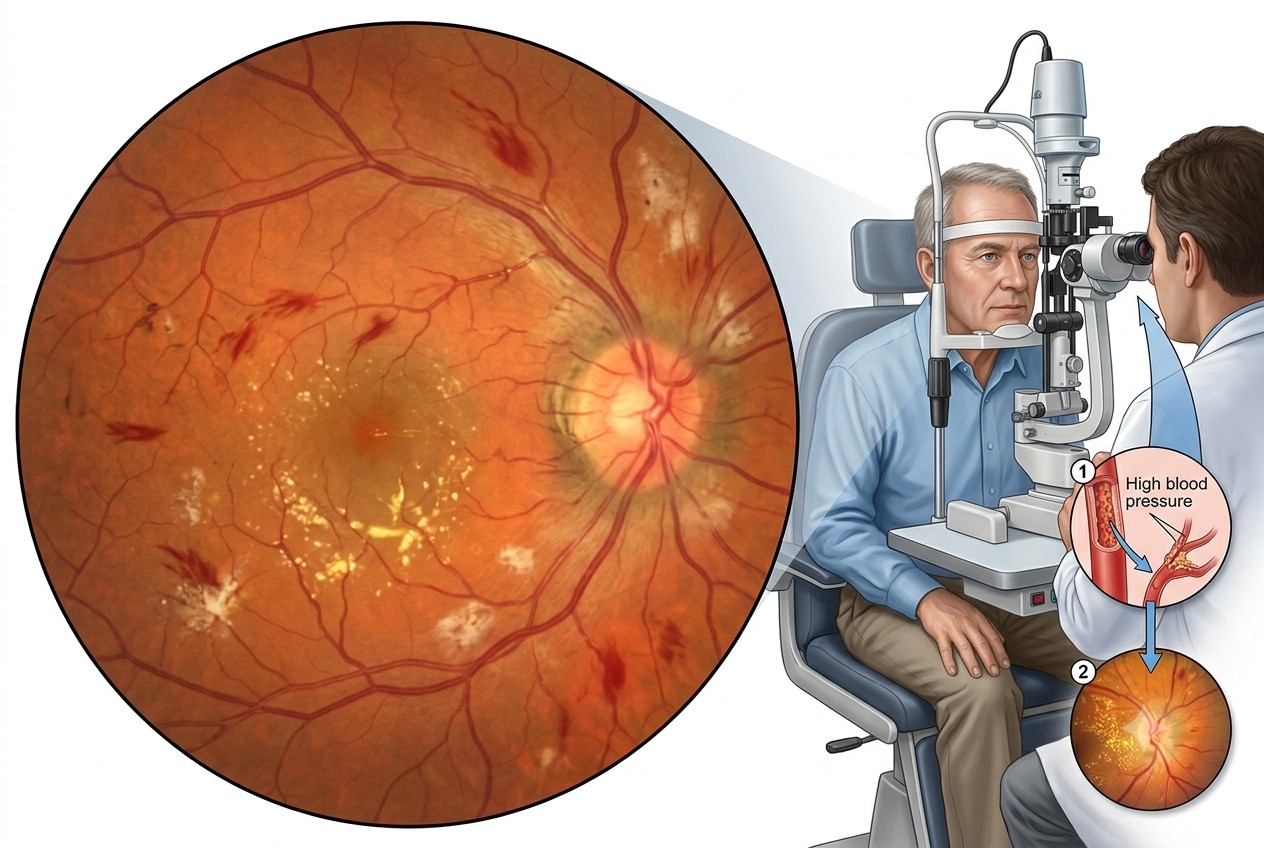
Hypertensive retinopathy is damage to the blood vessels that supply the retina. It happens when blood pressure stays high for a long time or rises suddenly. The high pressure damages the walls of the large retinal vessels, such as the central retinal artery and its branches and the central retinal vein and its branches. Parts of the blood then leak out of the vessels, and less blood flows to the retina.
What are the stages of hypertensive retinopathy?
The disease moves through stages, depending on how well blood pressure is controlled:
- Vasoconstrictive stage: When the pressure inside the vessels rises, the retina adjusts blood flow locally. This makes the retinal arteries tighten and narrow, so less blood reaches the retina.
- Sclerotic stage: The layers of the artery walls become thicker and stiffer. The narrowing of the arteries gets worse, and there are cuts or notches where arteries and veins cross (called arteriovenous nicking).
- Exudative stage: The blood-retinal barrier breaks down. Lipids (fats) leak onto the surface of the retina and form exudates (deposits). Plasma and blood also leak onto the retina and cause retinal edema (swelling). In addition, the narrowed vessels leave the retina and the optic nerve short of blood.
What are the symptoms of hypertensive retinopathy?
In the early stages, hypertensive retinopathy usually has no obvious signs in the eye. It is often found only when a doctor examines the back of the eye (a fundus exam).
Most people have problems that affect the whole body, such as chest pain, shortness of breath (while sleeping, exercising, or feeling nervous or excited), and short, quick breaths.
Eye symptoms appear only when blood pressure is very high (above 200/140 mmHg). They include:
- Blurred vision
- Swelling of the eye
- Eye pain
- Headache
- Double vision
- Reduced vision
- Sensitivity to light
What causes hypertensive retinopathy?
The cause is hardening (sclerosis) of the retinal arteries when blood pressure rises suddenly or stays high for a long time without good control. High blood pressure is defined as a systolic pressure above 140 mmHg and a diastolic pressure above 90 mmHg. When blood pressure is high, the blood pushes hard against the artery walls as it flows. Over time, this damages the arteries, including the arteries of the retina.
Most cases of high blood pressure have no identifiable cause. Some medical conditions can cause high blood pressure, including:
- Pheochromocytoma (a tumor of the adrenal gland)
- Cushing syndrome
- Kidney tissue disease
- Kidney blood vessel disease
- Coarctation of the aorta (narrowing of the aorta)
- Obstructive sleep apnea
- Overactive parathyroid glands and overactive thyroid
What are the risk factors?
Risk factors for hypertensive retinopathy include:
- Eating a lot of salt
- Not getting enough physical activity
- Obesity or being overweight
- Smoking
- Drinking a lot of alcohol
- A family history of the disease
- Long-term stress
- Chronic high blood pressure
- High cholesterol
- Diabetes
- Heart disease
- Atherosclerosis (hardening and narrowing of the arteries)
Some studies have also found that genetics are linked to a higher risk of hypertensive retinopathy.
Is hypertensive retinopathy dangerous?
Yes. Possible complications include:
- Blockage of the central retinal artery or its branches
- Blockage of the central retinal vein or its branches
- Retinal arterial macroaneurysm (a bulge in a retinal artery)
- Glaucoma
- Ischemic optic neuropathy (damage to the optic nerve from poor blood supply)
- Age-related macular degeneration
- Retinal artery embolism (a clot or other particle blocking a retinal artery)
- Bleeding into the vitreous (the gel inside the eye) and in front of the retina
- Formation of an epiretinal membrane (a thin layer of tissue on the surface of the retina)
- Tractional retinal detachment
- Chronic papilledema (long-lasting swelling of the optic disc), which can shrink the optic nerve and make vision very blurry
- Cystoid macular edema (swelling in the center of the retina)
- Severe vision loss that cannot be reversed
High blood pressure combined with diabetes also raises the risk of vision loss significantly. The later the stage of hypertensive retinopathy, the higher the person’s risk of coronary artery disease, stroke, and even death.
How is hypertensive retinopathy diagnosed?
A doctor makes the diagnosis based on:
- The history of high blood pressure, including blood pressure readings, how long it has been present, symptoms, complications, how severe the disease is, the medicines used, and how closely the person follows treatment
- A fundus exam (an exam of the back of the eye)
- Fluorescein angiography (an imaging test of the blood vessels in the eye)
- A heart exam
- A lung exam
- A nervous system exam
Hypertensive retinopathy is classified into four stages of severity:
- Stage 1: Long-lasting high blood pressure plus narrowing of the retinal arteries.
- Stage 2: Higher blood pressure, plus narrowing of the retinal arteries and arteriovenous crossing changes (where arteries and veins cross).
- Stage 3: Fairly high blood pressure for a long time, plus bleeding and exudates in the retina, damage to the heart, brain, kidneys, and retina, and shortness of breath with exertion.
- Stage 4: Very high blood pressure, plus the eye signs of stage 3 and papilledema (swelling of the optic disc), plus severe damage to the brain, heart, kidneys, and retina.
How is hypertensive retinopathy treated?
Treatment mainly focuses on controlling and lowering blood pressure. When complications have developed, they need to be treated as well. Treatment depends on the stage.
Stages 1 and 2
People are guided on lifestyle changes, take blood pressure medicine, and are monitored continuously. The doctor also checks the back of the eye every 6 months.
Stage 3
Treatment still focuses on stabilizing blood pressure through lifestyle changes and medicine. The doctor also evaluates the target organs (such as the heart, brain, and kidneys) to plan treatment if there is damage.
The back of the eye needs to be checked more often, every 1 to 3 months. If vision is below 3/10 (about 20/70 on a US eye chart) and new blood vessels are forming in the retina, the doctor injects a medicine that blocks the growth of new blood vessels (an anti-VEGF drug) into the eye. If there are new vessels or damage caused by poor blood supply, laser treatment (laser photocoagulation) is used. For bleeding into the vitreous that lasts a long time, a surgery called a vitrectomy is needed.
Stage 4
This stage is malignant (extremely severe) high blood pressure, and blood pressure must be lowered urgently. Once the person is stable, treatment is the same as in stage 3.
How can you prevent hypertensive retinopathy?
Regularly monitoring and treating high blood pressure is the way to keep hypertensive retinopathy from developing.
People with high blood pressure should:
- Take their medicine as directed by their doctor
- Exercise regularly
- Eat a healthy, balanced diet with plenty of fruits and vegetables
- Limit salt in their diet
- Quit smoking
- Limit caffeine and alcohol
- Maintain a healthy weight
- Get regular checkups
What is the outlook?
People with severe hypertensive retinopathy have a high risk of coronary artery disease, peripheral artery disease, and stroke. Among people with untreated malignant high blood pressure, 50% die within 2 months of diagnosis and nearly 90% die within 1 year.
Most changes in the retina improve once blood pressure is stable. In stage 4, however, some people have permanent damage to the optic nerve and the macula (the center of the retina), with severe vision loss that cannot be reversed, and even blindness.
In general, hypertensive retinopathy that is found and treated in time can be reversed. In severe stages the outlook is worse, and permanent complications sometimes remain. That is why everyone with high blood pressure should take blood pressure control seriously and get regular checkups, so that damage can be found early and treated promptly.
References
Medical disclaimer
FAQHealth content is for informational and educational purposes only. It is not a substitute for professional medical advice, diagnosis, or treatment. Always talk with your doctor or another qualified health professional about any questions you have about a medical condition.